
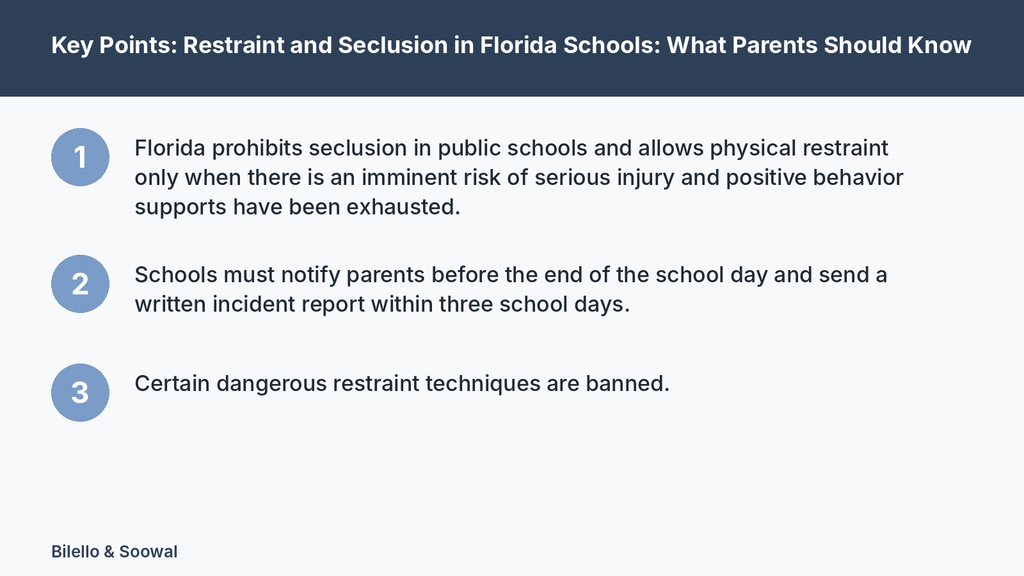
Florida prohibits seclusion in public schools and allows physical restraint only when there is an imminent risk of serious injury and positive behavior supports have been exhausted. Schools must notify parents before the end of the school day and send a written incident report within three school days. Certain dangerous restraint techniques are banned.
Reviewed by Nathan Soowal, attorney at Bilello & Soowal. Last reviewed November 2026.
Few things alarm parents more than learning their child was physically restrained or isolated at school. Students with disabilities are restrained far more often than other students, and many parents only learn about incidents after the fact. Florida has adopted strict rules, codified in section 1003.573 of the Florida Statutes, to limit these practices and protect students.
Here is what Florida law requires and what parents can do if they believe the rules were broken.
Seclusion Is Prohibited
Florida law prohibits seclusion in public schools. Seclusion means confining a student alone in a room or area from which the student is physically prevented from leaving. A time-out in an unlocked setting, where staff monitors the student and the student can leave, is generally not seclusion. If seclusion occurs anyway, it still must be reported.
When Restraint Is Allowed
Physical restraint may be used only in an emergency, when there is an imminent risk of serious injury to the student or others, and only after positive behavior interventions and supports have been exhausted. Restraint may never be used for discipline, convenience, or punishment. It must end as soon as the danger passes.
Prohibited Restraint Techniques
- Mechanical restraints such as straps, tie-downs, zip ties, or handcuffs used in ways that may restrict breathing or blood flow
- Restraint that restricts a student’s breathing
- Placing a student face down with hands held or restrained behind the back
- Techniques that apply weight to the student’s chest or back
School resource officers and law enforcement restraints involving students must also be reported.
Parent Notification Requirements
When a student is restrained, the school must:
- Provide written notice to the parent before the end of the school day
- Make reasonable efforts to reach the parent by phone or email and document those efforts
- Mail a completed incident report to the parent within three school days
- Keep a signed acknowledgment of notification and receipt
If you did not receive these notices, note the dates and raise the issue in writing.
What the Incident Report Must Include
Florida requires detailed incident reports, including the student’s information, the date, time, duration, and location, the type of restraint, the staff involved and their training dates, the behavior that led to the restraint, the interventions tried first, and any injuries. Schools report restraint data to the state, and the Florida Department of Education publishes restraint data by district.
Restraint and the IEP
Restraint should not be written into an IEP as a planned intervention. Frequent restraint is a sign that the student’s behavior plan is not working. Parents can request a functional behavior assessment, a new behavior intervention plan, and an IEP meeting to review supports. Learn more about how we handle disciplinary issues in special education.
Steps Parents Can Take After an Incident
- Ask for the incident report, notification records, and any video.
- Photograph any injuries and seek medical care if needed.
- Request an IEP or 504 meeting to review behavior supports.
- Ask for a functional behavior assessment.
- File a complaint with the district, the Florida Department of Education, or the federal Office for Civil Rights if rules were broken.
Talking to Your Child
Children may be frightened or confused after a restraint. Ask open questions about what happened, reassure them, and watch for changes in sleep, behavior, or willingness to attend school. Counseling may help.
When to Contact an Education Lawyer
If restraint is happening repeatedly, if your child was injured, or if the school failed to notify you, an attorney can request records, attend meetings, and push for safer supports. Legal help can also clarify whether the school violated state law or federal disability protections.