

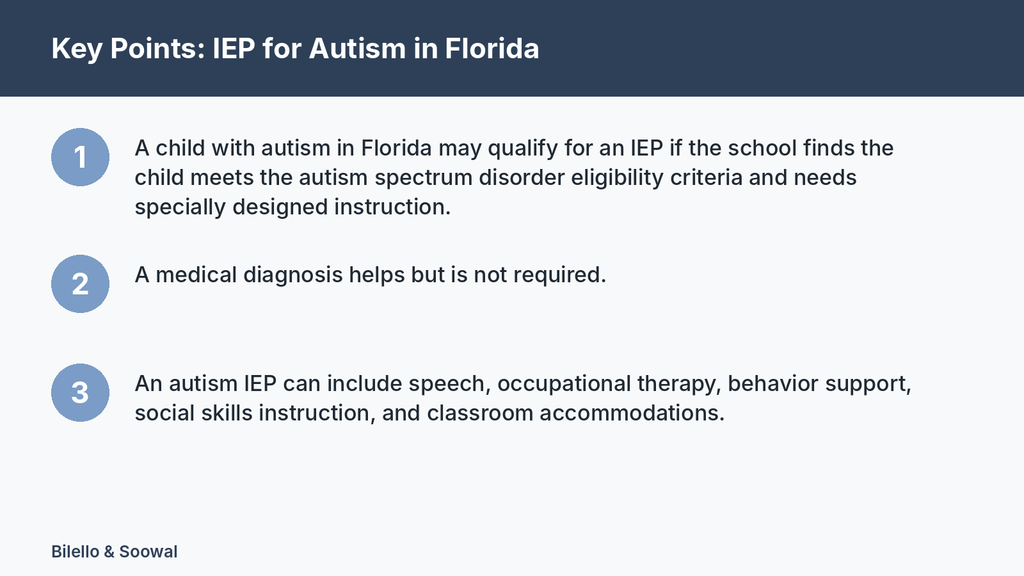
A child with autism in Florida may qualify for an IEP if the school finds the child meets the autism spectrum disorder eligibility criteria and needs specially designed instruction. A medical diagnosis helps but is not required. An autism IEP can include speech, occupational therapy, behavior support, social skills instruction, and classroom accommodations.
Reviewed by Nathan Soowal, attorney at Bilello & Soowal. Last reviewed November 2026.
A child with autism in Florida may qualify for an Individualized Education Program, or IEP, under the autism spectrum disorder eligibility category when the condition affects the child’s education and the child needs specially designed instruction. A medical diagnosis can support eligibility, but it is not required and does not guarantee it. The school district must evaluate the child and decide eligibility under Florida’s rules, and the IEP must then address all of the child’s needs, including communication, social, behavioral, and sensory needs, not just academics.
Parents in Broward County and across Florida often find that schools focus narrowly on grades. Many children with autism do well academically but struggle with communication, social interaction, transitions, or behavior. Federal and Florida law recognize that those needs are part of a child’s education.
How Autism Eligibility Works
| Step | What Happens |
|---|---|
| Referral | A parent or the school requests an evaluation in writing |
| Consent | The parent signs consent for the evaluation, which starts the timeline |
| Evaluation | The district assesses communication, social skills, behavior, academics, and other areas of concern |
| Eligibility meeting | The team decides whether the child meets the autism spectrum disorder criteria and needs specially designed instruction |
| IEP development | The team writes goals, services, accommodations, and placement |
Florida sets specific criteria for the autism spectrum disorder category, focused on social communication and restricted or repetitive behaviors that affect learning. Children who do not meet the autism criteria may still qualify under another category, such as speech or language impairment or other health impairment.
Services to Ask About
- Speech and language therapy, including social communication goals
- Occupational therapy for sensory and fine motor needs
- Behavior support, including a functional behavioral assessment and behavior intervention plan when needed
- Social skills instruction
- Specialized instruction in a general or specialized setting
- Assistive technology or communication devices
- Paraprofessional support when the child needs it
- Transition planning as the child approaches the teen years
Each service should tie back to a need identified in the evaluation and be supported by measurable goals.
Accommodations That Often Help
- Visual schedules and advance notice of changes
- Breaks and a quiet space for regulation
- Preferential seating and reduced sensory distractions
- Extended time and testing in a separate setting
- Clear, step-by-step directions
Preparing for the IEP Meeting
Parents are equal members of the IEP team. Before the meeting, ask for draft goals and evaluation reports in advance, write down your concerns and your child’s strengths, and bring reports from private providers such as speech therapists or behavior analysts. Ask how each goal will be measured and how often you will receive progress reports. You can bring someone with knowledge of your child, and you do not have to sign anything at the meeting.
Least Restrictive Environment
Students with autism have the right to be educated with peers without disabilities to the maximum extent appropriate. A school should consider supports in the general education classroom before moving a child to a more restrictive setting. Placement decisions should be based on the child’s individual needs, not on the diagnosis or on which programs are available.
Discipline and Behavior
Behavior is often communication for children with autism. When behavior leads to suspensions, the school may need to conduct a functional behavioral assessment and update the behavior plan. Removals that add up to more than 10 school days trigger additional protections, including a manifestation determination. Learn more about disciplinary issues for students with disabilities.
If the School Says No
If the district finds your child ineligible or offers services you believe are not enough, you have options. You can request an independent educational evaluation at public expense if you disagree with the school’s evaluation, ask for another IEP meeting, file a state complaint, request mediation, or file for a due process hearing. Keeping copies of all evaluations, emails, and progress reports helps at every step. Our guide to your child’s IEP rights in Florida explains these protections in more detail.
IEP or 504 Plan for a Child With Autism?
An IEP provides specially designed instruction and related services under the Individuals with Disabilities Education Act. A 504 plan provides accommodations, such as extra time or a quiet testing space, under Section 504 of the Rehabilitation Act, but it does not include specialized instruction.
Many students with autism need more than accommodations, especially for communication, social skills, and behavior. If a school offers only a 504 plan, parents can request a full evaluation for Exceptional Student Education services and ask for the reasons for the decision in writing.
Frequently Asked Questions
Does a child with autism automatically get an IEP?
No. The child must meet eligibility criteria and need specially designed instruction.
Do I need a medical diagnosis for an autism IEP in Florida?
No. A diagnosis can help, but the school makes its own educational eligibility decision.
What services can an autism IEP include?
Speech, occupational therapy, behavior support, social skills instruction, and specialized instruction, among others.
Can my child with autism stay in a general education classroom?
Often yes, with supports. Placement must be in the least restrictive appropriate environment.
What can I do if I disagree with the school’s evaluation?
You can request an independent educational evaluation at public expense and use dispute resolution options.
What does ESE mean in Florida schools?
ESE stands for Exceptional Student Education, which is the term Florida uses for special education programs and services.
What benefits do autistic children get in Florida?
Eligible students can receive ESE services through public schools, and some families use the Family Empowerment Scholarship for Students with Unique Abilities for approved therapies, tutoring, or private school.
Talk to a Florida Special Education Lawyer
Bilello & Soowal helps families in Broward County and across Florida secure appropriate evaluations and services for children with autism. When you call, our team will ask about your child’s needs, school records, and evaluations, then explain your rights and the next steps toward the right supports.