

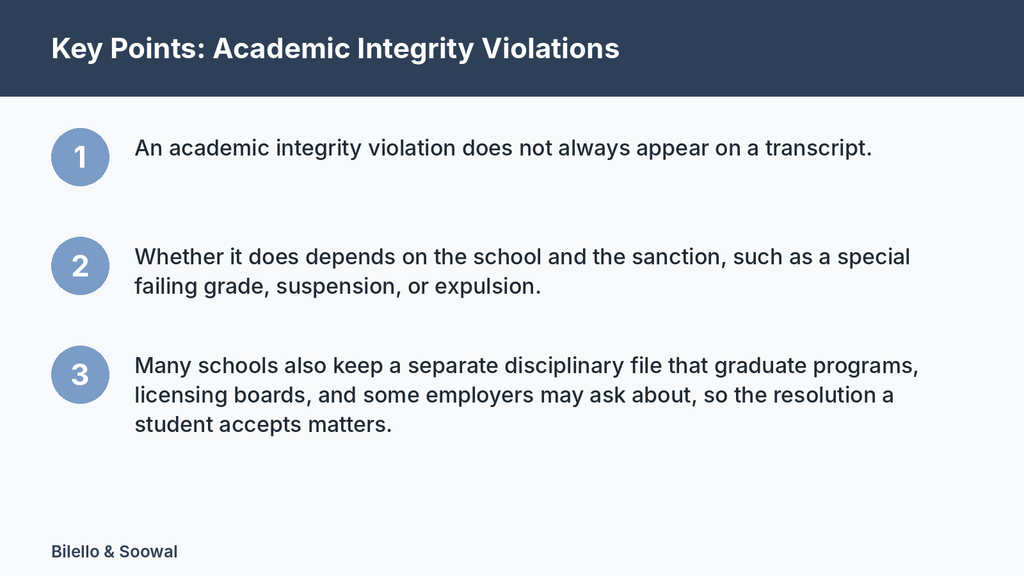
An academic integrity violation does not always appear on a transcript. Whether it does depends on the school and the sanction, such as a special failing grade, suspension, or expulsion. Many schools also keep a separate disciplinary file that graduate programs, licensing boards, and some employers may ask about, so the resolution a student accepts matters.
Reviewed by Nathan Soowal, attorney at Bilello & Soowal. Last reviewed November 2026.
An academic integrity violation does not always appear on your transcript, but it can. Depending on the school and the sanction, a finding may result only in a grade penalty and an internal disciplinary record, or it may produce a special failing grade or transcript notation that other schools and employers can see. Even when nothing appears on the transcript, graduate school, law school, and medical school applications often ask directly about academic discipline, and a disciplinary file can follow a student for years.
Students in Florida and across the country often accept a “first offense” outcome to make the case go away quickly, without understanding what it means for future applications. The long-term consequences usually depend less on the incident and more on how the sanction is recorded.
Where an Academic Integrity Finding Can Show Up
| Record | What It May Contain | Who Usually Sees It |
|---|---|---|
| Course grade | A reduced or failing grade in the course | Anyone who sees your transcript |
| Special failing grade | Some schools use a grade that signals failure due to academic dishonesty | Anyone who sees your transcript |
| Transcript notation | A note about suspension, expulsion, or a disciplinary finding | Anyone who sees your transcript |
| Internal disciplinary file | The complaint, finding, and sanction | School officials, and others with your consent or as allowed by law |
| Dean’s certification | A statement of disciplinary history sent at your request | Law schools, medical schools, and some programs |
Policies differ widely. Some schools remove special grades after a set period or after a student completes an integrity course. Others keep notations permanently. Reading your school’s policy is the first step.
Graduate and Professional School Disclosure
Many graduate programs ask whether you have ever been found responsible for academic misconduct or disciplinary violations. Law schools and medical schools often require a dean’s certification from your undergraduate institution. Bar admission later involves a character and fitness review that asks similar questions. Failing to disclose a required matter can be treated more seriously than the original violation. Honest, well-explained disclosure is usually far better than omission.
How to Explain a Violation on an Application
When disclosure is required, admissions committees look for honesty, accountability, and growth. A strong explanation briefly states what happened, the outcome, what you learned, and what has changed since. It avoids blaming professors or minimizing the conduct. A single incident early in college, followed by a clean record, is viewed very differently from repeated violations. Keeping your explanation consistent with the school’s records matters, because programs may compare the two.
Employment and Licensing
Most employers do not see disciplinary files unless the student authorizes release, and federal privacy law generally protects education records. However, a transcript notation is visible to anyone who receives the transcript. Some licensing boards and professional programs ask about academic discipline directly.
How Sanction Choices Affect the Record
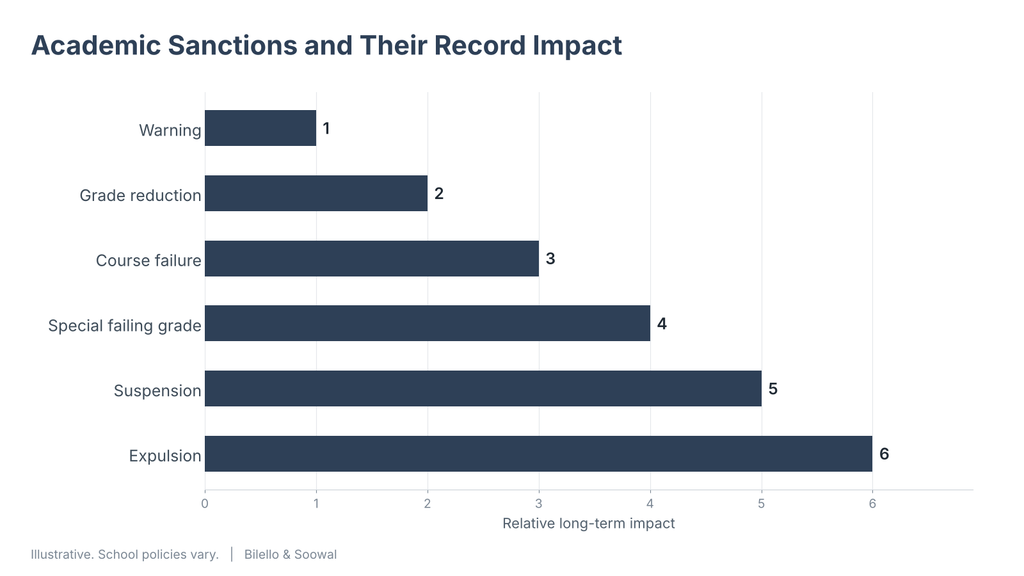
- A grade reduction with no formal finding may create little lasting record.
- A formal finding of responsibility usually creates a disciplinary file.
- Suspension or expulsion often produces a transcript notation.
- Agreeing to an informal resolution may still count as a finding, depending on school policy.
Before accepting any resolution, ask exactly what record will be created, where it will appear, and whether it can be removed later.
Options After a Finding
Students may be able to appeal a finding or sanction within a short deadline, often based on procedural errors, new evidence, or a disproportionate sanction. Some schools allow a petition to remove a special grade or notation after a set period. Requesting a copy of your disciplinary file lets you see exactly what a future school might learn. Learn more about our student disciplinary hearing representation.
Protecting Your Future Before the Hearing
- Read the integrity policy and the specific charge carefully.
- Gather drafts, notes, version histories, and communications that show your work.
- Avoid writing detailed statements before understanding the process.
- Ask in writing what sanctions are possible and how each is recorded.
- Note every deadline for responses and appeals.
Common Types of Academic Misconduct
Schools define academic misconduct in their codes of conduct, and the categories are broader than many students expect. Common examples include plagiarism, cheating on exams, unauthorized collaboration, fabricating data or citations, submitting the same work for more than one course, and helping another student cheat.
Unauthorized use of AI writing or coding tools is now a frequent allegation. Policies often vary by course, so a student accused of improper AI use should gather the syllabus, assignment instructions, and drafts that show how the work was created.
Frequently Asked Questions
Does an academic integrity violation go on your transcript?
Sometimes. It depends on the school and the sanction, such as a special failing grade or a suspension notation.
Do graduate schools find out about academic integrity violations?
Often, because applications ask directly and some programs require a dean’s certification.
Can an academic integrity notation be removed?
Some schools allow removal after a period or after completing a course. Others do not.
Should I accept a first offense resolution?
Only after understanding exactly what record it creates and how it must be disclosed.
Can I appeal an academic integrity finding?
Usually yes, within a short deadline and on grounds set by the school’s policy.
Are there automatic consequences for an academic integrity violation?
Few consequences are automatic. Most schools decide sanctions case by case, but many record any finding in a disciplinary file even when the grade penalty is small.
How long does academic misconduct stay on your record?
It depends on the school. Many keep disciplinary records for several years after a student leaves, and some keep suspension or expulsion records permanently.
Talk to a Student Defense Lawyer
Bilello & Soowal advises students and families facing academic integrity charges in Florida and beyond. When you call, our team will ask about the allegation, your school’s policy, and your future plans, then explain how to protect your record. Learn more about suspension and expulsion defense.