
When your child struggles in school because of a disability, few things feel more urgent, or more overwhelming, than making sure they get the support they are legally entitled to. In Florida, that support usually comes through an Individualized Education Program, or IEP, a legally binding plan developed under federal and state law. Yet many parents do not fully understand their rights, and schools do not always deliver everything the law requires. Knowing how the system works, and what you can demand, is the key to protecting your child’s education and future.
Key Takeaways
- An IEP is a legally enforceable plan guaranteeing your child a free appropriate public education.
- You are an equal member of the IEP team, with real rights to participate and disagree.
- Schools must follow the IEP as written; failing to do so can violate federal law.
- Parents have powerful dispute-resolution tools, including mediation and due process.
What an IEP Is and Why It Matters
An IEP is a written plan created for a child who qualifies for special education services under the federal Individuals with Disabilities Education Act. In Florida, these services fall under the umbrella of Exceptional Student Education. The IEP spells out your child’s specific needs, measurable goals, the services and accommodations the school will provide, and how progress will be measured. Crucially, it is not a suggestion; it is a legally binding document. When a school fails to provide what the IEP promises, it is not merely disappointing, it can be a violation of your child’s rights under federal law, and skilled help with special education law can hold the district accountable.
Special Education in Florida (2024–2025)
- Florida served 448,482 students with disabilities, about 15.7% of all public school students.
- Specific learning disabilities account for roughly 32% of eligible students.
- Districts reported over 2,079 unfilled ESE positions.
- More than 10,167 ESE courses were taught by educators lacking appropriate special education certification.
IEP vs. 504 Plan: Know the Difference
Parents often confuse IEPs with 504 plans, but they are governed by different laws and offer different protections. An IEP, under IDEA, provides specialized instruction and related services for children who qualify under specific disability categories and need special education. A 504 plan in Florida, under a separate civil rights law, provides accommodations to ensure a child with a disability can access the same education as their peers, but it does not include specialized instruction. Choosing the right path, and recognizing when a school steers a family toward a weaker plan than the child needs, is an important part of protecting your child’s rights within the broader framework of education law.
How a Child Becomes Eligible
The process begins with identification and evaluation. Under a duty often called “Child Find,” schools are legally required to identify and evaluate children who may need special education, and parents can also formally request an evaluation. The school must obtain consent, conduct a comprehensive assessment, and determine eligibility based on the results. If your child qualifies, an IEP team is convened to build the plan. Parents sometimes wait too long, assuming the school will act on its own, when a written request can start the clock and trigger legal deadlines the district must meet.
| ❝ What Clients Say “Bilello & Soowal treated me like family. They were responsive, thorough, and always had my best interests at heart.” (David R., Bilello & Soowal client) |
You Are an Equal Member of the IEP Team
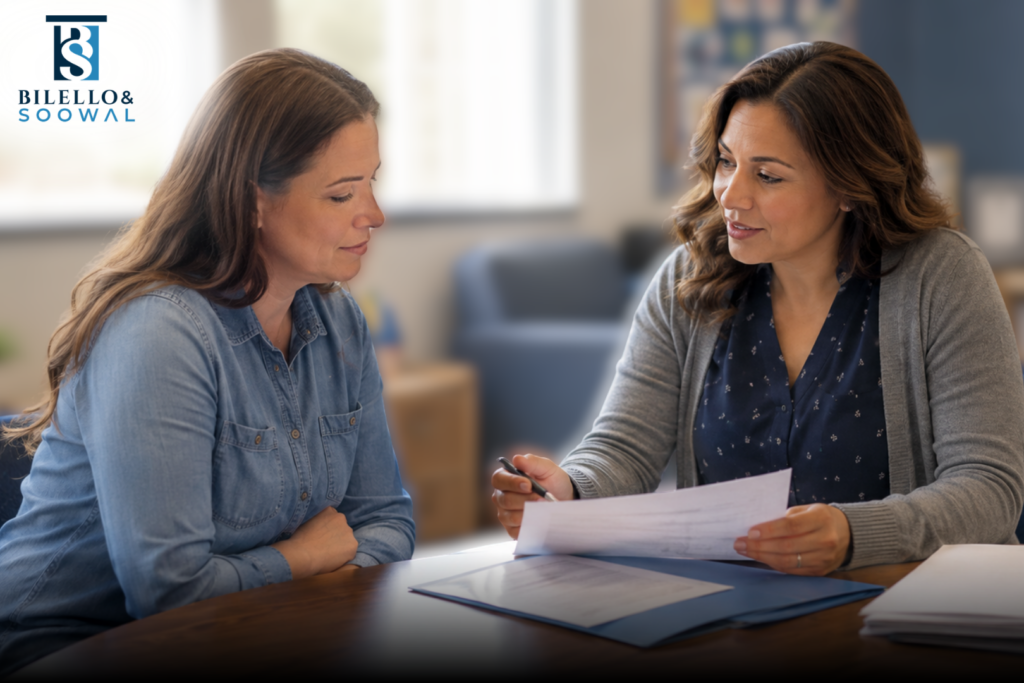
One of the most important and least understood facts about the IEP process is that parents are equal members of the team, not spectators. You have the right to attend meetings, review your child’s records, contribute to the goals, and disagree with the school’s proposals. The IEP must be reviewed at least once a year, and you can request a meeting sooner if your child’s needs change or the plan is not working. Coming prepared with your own observations, documents, and questions, and understanding that your voice carries legal weight, can dramatically change the outcome for your child.
When the School Falls Short
Unfortunately, having an IEP on paper does not guarantee it will be followed. Overcrowded classrooms, staffing shortages, and budget pressures can lead schools to quietly fail to deliver promised services. Warning signs include missed therapy sessions, accommodations that never materialize, a lack of progress on goals, or a child who is repeatedly disciplined for behavior connected to their disability. In fact, disability-related discipline can raise separate legal issues, and situations involving suspensions or expulsions may call for experienced student defense to protect both a child’s education and their record.
Your Options When You Disagree
Parents are not powerless when they disagree with a school. Federal and Florida law provide several dispute-resolution tools. You can request an IEP meeting to address concerns, seek an independent educational evaluation at public expense in certain circumstances, pursue mediation with a neutral third party, file a formal state complaint, or request a due process hearing before an impartial officer. Each option has its own procedures and deadlines, and choosing the right one depends on the situation. Escalating thoughtfully, rather than emotionally, is usually the most effective way to get results for your child.
How to Prepare for a Successful IEP Meeting
Walking into an IEP meeting prepared can change the entire tone and outcome. Before the meeting, request and review your child’s complete educational and evaluation records, and make note of anything that seems inaccurate or incomplete. Write down specific, concrete examples of where your child is struggling and where they are thriving, because real-world details carry more weight than general concerns. Come with a short list of goals you want addressed and questions you want answered, and do not be afraid to ask the team to explain any term or recommendation you do not understand. You have the right to bring someone with you, whether a family member, an advocate, or an attorney, and you are never required to sign the IEP on the spot. If you need time to review the document, you can take it home before agreeing. Finally, keep a written record of every meeting, email, and phone call, because a clear paper trail is one of the most powerful tools a parent has if a dispute later arises.
Frequently Asked Questions
How long does the school have to evaluate my child?
Once you provide consent, the school must complete the evaluation and determine eligibility within legally set timelines. If the district delays, that itself can be a violation of your rights.
Can the school change my child’s IEP without me?
Generally no. Parents are members of the IEP team, and significant changes require the team’s involvement. You have the right to participate and to disagree.
What if my child is disabled but the school says they do not qualify?
A denial is not the final word. You can challenge the decision, request an independent evaluation, and pursue dispute resolution to secure the services your child needs.
Talk to a Florida Special Education Attorney
Your child has a legal right to an appropriate education, and you do not have to fight the school system alone. Whether your child needs an initial evaluation, a stronger IEP, or enforcement of a plan the district is ignoring, Bilello & Soowal helps Florida families protect their children’s rights and futures. Contact Bilello & Soowal at (833) 848-2878 to discuss your child’s situation and take the next step toward the support they deserve.