
AI Quick Answer
If your child was arrested at school in Florida, your immediate priorities are: (1) do not let your child speak to law enforcement without an attorney, (2) contact a Florida juvenile defense attorney within hours, not days, (3) understand that a detention hearing must occur within 24 hours if your child is held under Florida Statute 985.26, and (4) recognize that school disciplinary proceedings run separately from the legal case. The attorneys at Bilello & Soowal, PLLC handle both.
When a school resource officer (SRO) handcuffs your child and walks them out of a classroom, the next 24 hours can determine the trajectory of their entire future. A juvenile arrest at school in Florida is not just a disciplinary matter; it triggers a fast-moving legal process, and the mistakes parents make in those first hours are often the hardest to undo.
At Bilello & Soowal, PLLC, our student defense lawyers work with families across South Florida and Orlando who are navigating exactly this crisis. This guide explains what Florida juvenile law requires, what your rights are, and what you need to do right now.
How common is juvenile arrest at school in Florida?
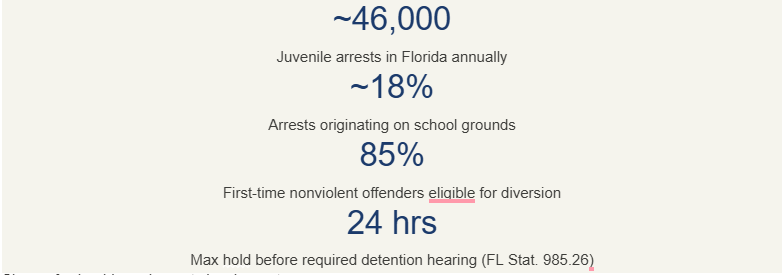
Share of school-based arrests by charge type
Source: Florida Department of Juvenile Justice annual report data
Understanding that your child has entered a formal legal process is the first and most important mental shift a parent needs to make.
Step 1: Stay calm and do not go to the school demanding answers
Your instinct is to race to the school. In most cases, that is the wrong first move. When a child is arrested at school in Florida, they are typically transported directly to a Department of Juvenile Justice (DJJ) intake facility, not held at the school. Arriving agitated and demanding information from staff or the SRO can create a confrontational record that follows your family through the case.
What to do instead: call the school’s front office calmly to confirm what happened and where your child has been taken. Write down every name, badge number, and detail you receive. Then call a Florida juvenile defense attorney immediately.
Step 2: Do not let your child speak to law enforcement without an attorney
Critical rights reminder
- Your child has the absolute right to remain silent under the Fifth Amendment.
- This applies at DJJ intake, in the patrol car, and in any school office setting.
- School resource officers and DJJ intake officers are trained interviewers.
- Anything your child says can and will be used in the juvenile proceeding.
- Instruct your child clearly: say nothing and ask to speak to an attorney.
This is the single most important instruction in this entire guide. Florida law gives juveniles the same Fifth Amendment rights as adults. SROs may tell your child that cooperation will help them and frame the conversation informally. It is not informal.
At Bilello & Soowal, PLLC, we have seen cases where a single voluntary statement made at intake significantly narrowed a family’s options. Do not let that happen to your child.
Step 3: Understand the Florida juvenile arrest process and your timeline
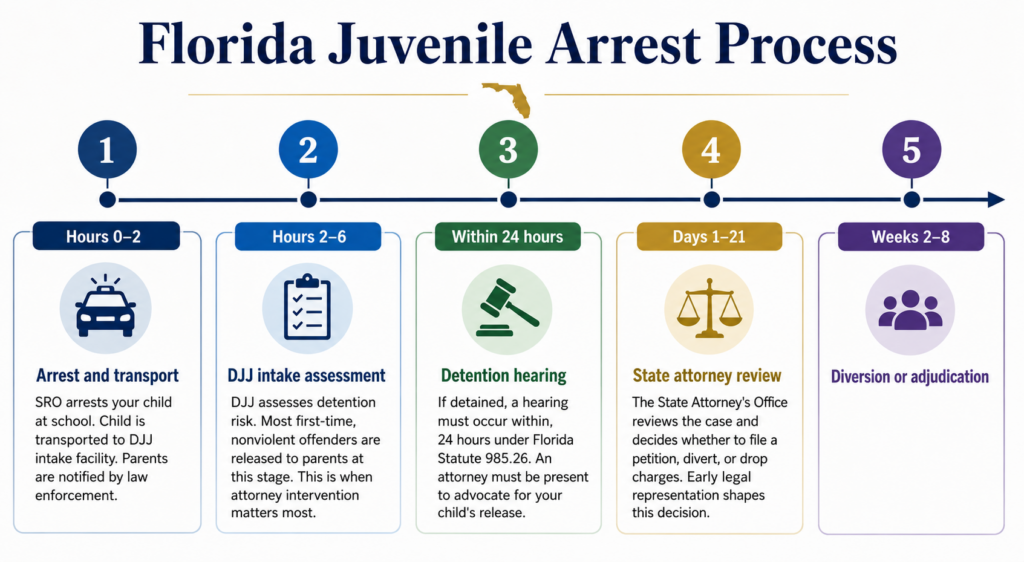
Eligible juveniles enter Florida’s civil citation or diversion program. Completing diversion keeps the arrest off their permanent record.
The most critical window is the DJJ intake assessment. Without an attorney engaged during this window, families often lose access to diversion options before they even know they existed.
Step 4: Contact a Florida juvenile defense attorney immediately
Many parents wait. They assume the school will handle it, or that a first offense will not amount to much. This is one of the most costly mistakes a family can make.
Under Florida Statute 985, the juvenile justice process moves on its own timeline regardless of whether your family is ready. The State Attorney’s Office begins reviewing cases quickly, and early intervention by a juvenile defense attorney can mean the difference between diversion and formal adjudication.
The attorneys at Bilello & Soowal, PLLC represent students and families across Broward County, Fort Lauderdale, and Orlando. We know how Florida’s Department of Juvenile Justice operates and how to advocate for your child at every stage — from the intake facility to the courtroom.
Step 5: The school-side consequences run separately from the legal case
A juvenile arrest at school in Florida triggers two parallel processes. Your child can be cleared legally and still face suspension or expulsion. They can also face consequences that affect their IEP, 504 plan accommodations, or college admissions record.
| Issue | Legal process | School disciplinary |
| Who controls it | State Attorney / Juvenile Court | School principal / district |
| Governed by | Florida Statute 985 | School code of conduct / IDEA |
| Can result in | Adjudication, diversion, probation | Suspension, expulsion, record notation |
| College applications | Yes, if adjudicated | Yes, via disciplinary disclosure |
| Can be expunged | Yes, under conditions | Separate process required |
| IEP and 504 rights | Limited | Yes, directly protected |
At Bilello & Soowal, PLLC, we handle both sides. Our education law practice means we can simultaneously defend your child’s legal case and push back against any school discipline that exceeds what Florida law permits, including advocating for students with disabilities whose rights under IDEA may have been violated during the arrest itself.
What parents should never do after a child is arrested at school
- Do not post anything on social media about the incident
- Do not allow your child to discuss the arrest with friends, teachers, or school staff
- Do not sign any documents presented by the school without legal review
- Do not assume the school’s version of events is accurate or complete
- Do not wait to contact an attorney, even if the charge seems minor
- Do not allow your child to be interviewed by school administrators without counsel present
Frequently asked questions
Do Florida parents get notified when their child is arrested at school?
Yes. Florida law requires that parents or guardians be notified as soon as possible after a juvenile arrest. However, notification does not mean your child will be released immediately. They may already be in DJJ intake processing by the time you are reached.
Can a school resource officer arrest a child in Florida without a parent present?
Yes. SROs are sworn law enforcement officers with full arrest authority. A parent does not need to be present for a Florida juvenile arrest to occur. Your child’s rights apply from the moment of detention, which is why knowing to request an attorney immediately is essential.
What is Florida’s civil citation program for juveniles?
Florida’s civil citation program is an alternative to formal arrest for first-time, nonviolent juvenile offenders. Instead of entering the juvenile justice system, the child completes community service and other requirements. Successful completion means no formal arrest record. Eligibility depends on the charge and the county.
Will a juvenile arrest in Florida show up on a college application?
It depends on whether the case was diverted, adjudicated, or expunged. A formal adjudication of delinquency can appear on background checks and may be disclosed on college applications. Expunction is possible in Florida under certain conditions — another reason early legal intervention matters.
Can a child be handcuffed at school in Florida?
Yes. School resource officers follow law enforcement protocols, which can include handcuffing. If you believe excessive force was used or that your child’s rights were violated during the arrest, document everything and raise it with your attorney immediately.
What should I say when I call a juvenile defense attorney?
Tell them your child’s name and age, the school and county where the arrest occurred, the charge if you know it, and where your child is being held. The attorneys at Bilello & Soowal, PLLC offer free consultations and can advise you immediately on next steps.
Your Child Needs a Florida Juvenile Defense Attorney Now
Bilello & Soowal, PLLC serves families inBroward County, Fort Lauderdale, Pompano Beach, Deerfield Beach, and Orlando. Call our office at (833) 848-2878 to schedule a consultation.