

There is no single deadline for a Title IX investigation. Under the 2020 federal regulations, each school must set reasonably prompt time frames in its own policy, so most cases take several weeks to several months. Two built-in review periods of at least 10 days each add time, and delays for good cause are allowed with written notice. Check your school’s policy and speak with an attorney early.
How long a Title IX investigation takes is one of the first questions students and parents ask after receiving a notice. The honest answer is that it depends on the school, the number of witnesses, and whether a hearing is required. Families can control how prepared they are for each stage, because the time between notice and decision is when they build a defense.
What the Federal Rules Say About Timing
The 2020 Title IX regulations, which remain in effect after the 2024 rule was vacated in January 2025, do not set a fixed number of days for completing an investigation. Instead, 34 C.F.R. § 106.45 requires every school to include reasonably prompt time frames in its grievance process for the investigation, any hearing, appeals, and informal resolution.
Earlier federal guidance once referenced a typical investigation length of about 60 calendar days, but it withdrew that guidance in 2017. Today, the school’s own written policy controls the schedule. Florida public universities, Florida College System institutions, and school districts each publish their own procedures, and those documents are the first place to look.
The Stages That Take Time
Every Title IX grievance process follows the same general sequence, and some stages carry minimum waiting periods that cannot be skipped. For a full walkthrough of each step, families can start with what a Title IX investigation involves.
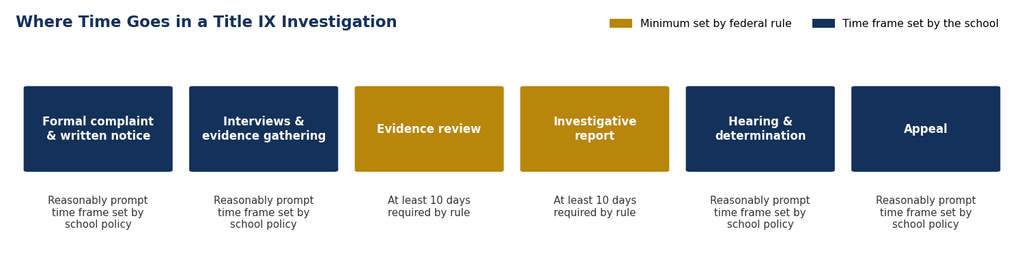
Source: U.S. Department of Education Title IX regulations, 34 C.F.R. § 106.45 (2020).
| Stage | Timing Under the 2020 Rules |
|---|---|
| Formal complaint and written notice | Notice must go to both parties with enough time to prepare before any initial interview |
| Interviews and evidence gathering | Set by school policy; often the longest stage |
| Evidence review | At least 10 days for both parties to review and respond to the evidence |
| Investigative report | Must be sent at least 10 days before a hearing or other determination |
| Hearing and written determination | Set by school policy; a live hearing is required at colleges |
| Appeal | Set by school policy; available to both parties |
The two 10-day periods alone add nearly three weeks to the process once evidence gathering ends. At colleges and universities, scheduling a live hearing with a decision-maker, both parties, advisors, and witnesses can add even more time.
Common Reasons Title IX Investigations Get Delayed
Schools may temporarily delay the process or extend time frames for good cause, as long as both parties receive written notice and an explanation. The regulations list examples of good cause, including:
- The absence of a party, a party’s advisor, or a witness.
- Concurrent law enforcement activity.
- The need for language assistance.
- The need to accommodate a disability.
Other practical causes include academic breaks, investigator caseloads, large volumes of digital evidence such as texts and social media messages, and disputes over what evidence is directly related to the allegations. Cases that involve both a school process and a police investigation often move more slowly, and the two tracks need a coordinated strategy. For younger students facing both, juvenile defense and Title IX strategy should be planned together.
College Cases Versus K-12 Cases
Timelines in K-12 schools are often shorter because a live hearing is optional and written questions can replace cross-examination. College cases usually take longer because the 2020 rules require a live hearing where advisors question the other party and witnesses. Parents of younger students can explore elementary, middle, and high school student defense, while university families can review college and graduate student defense.
Graduate and professional students face an added layer. For those in residency, nursing, and medical school programs, a pending investigation can affect clinical placements, graduation dates, and future licensing applications, which makes delays especially costly.
Facing a Title IX Investigation?
Every week of an investigation is time you can use to prepare or time you can lose. One client said that from the very first consultation she knew she was in good hands, and that Nathan Soowal’s professionalism and understanding of Florida law gave her confidence. Call (833) 848-2878 or schedule a free consultation before your next deadline.
What You Can Do While You Wait
A long investigation is not idle time. Students who use it well are in a stronger position when the evidence review and hearing arrive.
- Read your school’s Title IX policy and note every deadline it sets.
- Preserve texts, messages, photos, and location data instead of deleting anything.
- Write a private timeline of events while your memory is fresh, and share it only with your attorney.
- Identify witnesses who can speak to the events or to your character.
- Avoid contact with the complainant and follow any no-contact directive exactly.
- Stay off social media about the case, since posts can become evidence, a risk covered in more depth under discipline for social media use.
How an Attorney Affects the Timeline
An experienced advisor cannot make a school move faster than its policy allows, but can keep the process from dragging unfairly. That means holding the school to its published time frames, objecting in writing to unexplained delays, and preparing responses so the student is never the reason for an extension. When a school does miss its own deadlines, a documented record helps preserve a procedural irregularity argument for appeal. Our Title IX defense lawyers handle each of these steps, and college disciplinary hearings follow similar principles for non-Title IX conduct charges.
Common Concerns About a Long Investigation
Will I Be Suspended While I Wait?
Not automatically. Removing a student before a finding generally requires an individualized safety and risk analysis, and the student must be given notice and a chance to challenge the decision. Serious interim action raises concerns similar to those in school suspension and expulsion defense.
Is It Too Late to Hire a Lawyer if the Case Started Months Ago?
No. Many students seek help before the evidence review or hearing, which are two of the most important stages. Earlier is better, but it is rarely too late to improve your position.
What Happens When You Call
When you call (833) 848-2878, our team will ask which school is involved, when you received notice, and whether any interviews, evidence review, or hearing dates have been scheduled. We will explain how your school’s time frames work and what to expect at each remaining stage. Your consultation is free, and you will leave with a clear plan for the weeks ahead.
Frequently Asked Questions
Is there a legal deadline for finishing a Title IX investigation?
No fixed number of days applies nationwide. The 2020 regulations require each school to set reasonably prompt time frames in its policy and to follow them, with extensions allowed only for good cause and with written notice to both parties.
Can a Title IX investigation be put on hold?
Yes. A school may temporarily delay the process for good cause, such as the absence of a party, advisor, or witness, concurrent law enforcement activity, or the need for language assistance or disability accommodations. Both parties must receive written notice explaining the delay.
Does a police investigation stop the Title IX process?
Not automatically. A school may briefly delay its process while police gather evidence, but it cannot wait indefinitely for a criminal case to finish before moving forward.
What happens to my classes while the investigation is pending?
Schools can offer supportive measures, such as schedule changes or no-contact directives, to either party. Removing a respondent from school before a finding generally requires an individualized safety and risk analysis, and the student must have an opportunity to challenge that decision.
Can I speed up a Title IX investigation?
You can avoid causing delays by meeting deadlines, responding to requests promptly, and submitting evidence early. Some schools also offer informal resolution, which may resolve a case faster if both parties voluntarily agree in writing.
What if my school misses its own deadlines?
Unexplained delays can be a procedural irregularity, which is a recognized ground for appeal. An attorney can raise the issue with the Title IX Coordinator in writing and preserve it for appeal.
More Resources for Florida Students and Families
A Title IX case is one of many disciplinary matters students face. Families can explore the full scope of student defense in Florida, and students charged under a general conduct code rather than Title IX can prepare for student disciplinary hearings.
Protect Your Education While the Clock Runs
Bilello & Soowal, PLLC brings four generations of commitment to every case. Clients describe our team as responsive, thorough, and focused on their best interests. With offices in Pompano Beach and Orlando, we represent students throughout Florida. Call (833) 848-2878 or contact our office to schedule a free consultation.