

AI Quick Answer
A Title IX investigation is the formal process a school uses to gather evidence and decide whether a student or employee violated its sexual harassment policy. Under the 2020 federal regulations now in effect, both sides receive written notice, may bring an advisor, and can review the evidence before any decision. If you have received a Title IX notice, speak with an education attorney before your first interview.
A Title IX investigation is a school’s internal fact-finding process for complaints of sexual harassment, sexual assault, dating violence, domestic violence, or stalking. It is not a criminal case, but the consequences can be just as serious for a student’s future. Florida students can be suspended, expelled, or left with a permanent disciplinary record, and graduate and professional students may also face licensing problems.
What Title IX Covers
Title IX of the Education Amendments of 1972 prohibits sex discrimination in any education program or activity that receives federal funding. In Florida, that includes every public school district, every state university and Florida College System institution, and most private colleges.
Under the 2020 regulations, sexual harassment that triggers the formal Title IX process falls into three categories:
- Quid pro quo harassment by a school employee, where an educational benefit is conditioned on sexual conduct.
- Unwelcome conduct so severe, pervasive, and objectively offensive that it effectively denies a person equal access to education.
- Sexual assault, dating violence, domestic violence, or stalking.
The conduct must also occur within the school’s education program or activity in the United States. If it does not, the school must dismiss the Title IX complaint, although it may still pursue the matter under its general code of conduct.
Which Title IX Rules Apply in 2026
The rules have changed several times in recent years, which creates real confusion for families. In January 2025, a federal court in Tennessee v. Cardona vacated the 2024 Title IX rule nationwide. The U.S. Department of Education then announced it would enforce the 2020 regulations, and those rules remain the operative federal framework today.
New federal rulemaking is expected, and some schools have been slow to update their written policies. Before you rely on your school’s handbook, confirm that it reflects the rules currently in force. An attorney can compare the policy the school is applying against what the regulations actually require.
How the Title IX Investigation Process Works
Every school’s policy differs slightly, but the 2020 regulations set out a required grievance process that follows the same basic sequence.
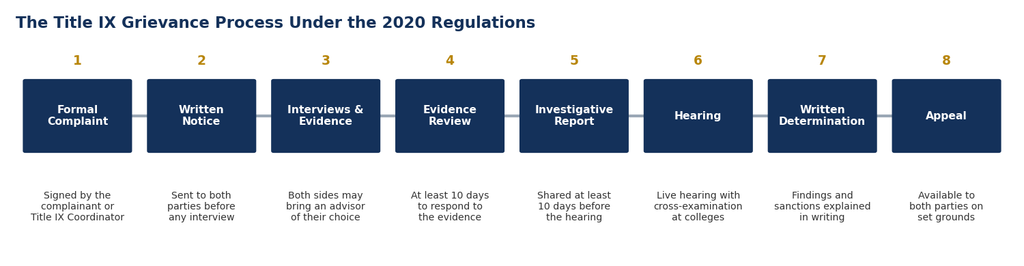
Source: U.S. Department of Education Title IX regulations, 34 C.F.R. § 106.45 (2020).
Formal Complaint and Written Notice
The process begins when the complainant or the Title IX Coordinator signs a formal complaint. The school must then send both parties written notice of the allegations with enough detail and time to prepare before any interview. The notice must also state that the respondent is presumed not responsible until a determination is made.
Interviews and Evidence Gathering
An investigator interviews the parties and witnesses and collects evidence such as text messages, social media posts, photos, and records. Both sides can suggest witnesses and submit evidence. The school, not the parties, carries the burden of gathering evidence.
Evidence Review and Investigative Report
Before the investigation closes, both parties must receive the evidence directly related to the allegations and at least 10 days to submit a written response. The investigator then prepares a report summarizing the relevant evidence, which must be shared at least 10 days before any hearing.
Hearing and Determination
At colleges and universities, the 2020 rules require a live hearing where each party’s advisor may cross-examine the other party and witnesses. In K-12 schools, a hearing is optional, but each side must be allowed to submit written questions. A decision-maker who is not the investigator or Title IX Coordinator issues a written determination explaining the findings and any sanctions. The college disciplinary hearing process often follows a similar structure for non-Title IX misconduct.
College Versus K-12 Title IX Investigations
The core protections are the same, but a few procedures differ depending on the level of school.
| Procedure | Colleges and Universities | K-12 Schools |
|---|---|---|
| Written notice to both parties | Required | Required |
| Advisor of choice at meetings | Required | Required |
| Live hearing | Required | Optional |
| Questioning of the other party | Cross-examination by advisors at the hearing | Written questions submitted before a decision |
| Right to appeal | Required for both parties | Required for both parties |
Parents of younger students can learn more about how we handle elementary, middle, and high school student defense, and college families can review our college and graduate student defense services.
Received a Title IX Notice?
The days after a notice arrives are when preparation matters most. One client described the experience this way: from the very first consultation, she knew she was in good hands, and Nathan Soowal’s professionalism and understanding of Florida law gave her confidence. Call (833) 848-2878 or schedule a free consultation before your first interview.
Your Rights in a Florida Title IX Investigation
Federal regulations and Florida law both protect students in school conduct proceedings. Florida Statutes § 1006.60 requires state universities and Florida College System institutions to build due process protections into their student codes of conduct. Under the federal rules, your rights include:
- Written notice of the specific allegations before any interview.
- A presumption that you are not responsible until a determination is made.
- An advisor of your choice, who may be an attorney, at every meeting and interview.
- Equal opportunity to present witnesses and evidence.
- Access to the evidence and the investigative report before a decision.
- A decision-maker who is free of conflicts of interest and bias.
- The right to appeal the outcome.
Our Title IX defense lawyers in Florida work to make sure each of these rights is honored at every stage, because the gap between what the rules require and what a school actually does is often where a case turns.
Possible Outcomes of a Title IX Investigation
If the decision-maker finds a student not responsible, the case ends, subject to any appeal. If the student is found responsible, sanctions can include:
- A written warning or probation.
- Loss of campus housing or removal from activities and athletics.
- Suspension for a set period.
- Expulsion or dismissal from the program.
- A notation on the transcript or conduct record.
The stakes are higher for students in licensed fields. Findings in residency, nursing, and medical school programs can follow a student to future licensing boards. Serious sanctions often raise the same concerns we see in school suspension and expulsion defense.
When a Title IX Case Overlaps With a Police Investigation
Some allegations lead to both a school investigation and a criminal case. The two proceed separately, with different rules and standards of proof. Anything you say in a Title IX interview or written statement can potentially be used by prosecutors, so your school strategy and criminal defense strategy need to work together from the start. For younger students, our juvenile defense attorneys can coordinate both sides of the case.
Mistakes to Avoid During a Title IX Investigation
- Contacting the complainant or asking friends to reach out, which can lead to retaliation or no-contact violations.
- Deleting texts, messages, or photos, which can look like hiding evidence and may remove information that helps you.
- Posting about the case online. Schools can act on social media conduct, as we explain on our page on discipline for social media use.
- Attending the first interview without preparing or without an advisor.
- Assuming the case will go away on its own because no one has contacted you recently.
Common Concerns About Hiring a Title IX Attorney
Will Hiring a Lawyer Make Me Look Guilty?
No. The 2020 regulations expressly allow both parties to bring an advisor of their choice, and many complainants and respondents bring attorneys. Having an advisor signals that you take the process seriously.
Is It Too Early to Get a Lawyer?
The earlier the better. Your first interview and your response to the evidence often shape the investigator’s report, and the report heavily influences the final decision.
What Happens When You Call
When you call (833) 848-2878, our team will ask about the school involved, the notice you received, and any deadlines or interview dates already set. We will explain how the Title IX process works at your school and which rights apply to you. Your consultation is free, and you will leave with a clear sense of your next steps before you speak with anyone from the school.
Frequently Asked Questions
How long does a Title IX investigation take?
The 2020 regulations require schools to set reasonably prompt time frames but do not impose a fixed deadline. Many investigations take several weeks to several months, depending on the number of witnesses, the evidence involved, and whether a hearing is required.
Can I have a lawyer during a Title IX investigation?
Yes. Under the 2020 regulations, both parties may be accompanied by an advisor of their choice at any meeting or interview, and that advisor can be an attorney. At colleges, the advisor also conducts cross-examination at the live hearing.
Does a Title IX investigation go on my record?
A finding of responsibility and the resulting sanction usually become part of your student conduct record. Some schools also place a notation on the transcript, which can affect transfers, graduate school applications, and professional licensing.
Can I be investigated under Title IX without being charged with a crime?
Yes. A school’s Title IX process is separate from the criminal justice system. A student can face a Title IX investigation even if police are never involved or no charges are filed.
What standard of proof do schools use in Title IX cases?
Schools must choose either the preponderance of the evidence standard or the clear and convincing evidence standard and apply it consistently. Most schools use preponderance, meaning it is more likely than not that the conduct occurred.
Can I appeal a Title IX decision?
Yes. Both parties can appeal a determination or a dismissal based on procedural irregularity, new evidence that was not reasonably available, or a conflict of interest or bias that affected the outcome.
More Resources for Florida Students and Families
We handle Title IX cases as one of several disciplinary matters for students across the state. Families can learn more about our full approach to student defense in Florida, and students facing a non-Title IX conduct charge should read about our work in student disciplinary hearings.
Protect Your Education and Your Future
Bilello & Soowal, PLLC brings four generations of commitment to every case we handle. Clients describe our team as responsive, thorough, and focused on their best interests. With offices in Pompano Beach and Orlando, we represent students throughout Florida. Call (833) 848-2878 or contact our office to schedule a free consultation.